K-Pop fans reading anti-K-Pop: Religion, identity, and subjectivity
- Authors
-
-
Okta Nurul HidayatiUIN Raden Mas Said Surakarta, Indonesia
-
- Keywords
- K-pop, Muslim women, Post-Islamism, Critical Discourse Analysis (CDA), audience reception
- Abstract
The expansion of K-pop fandom among young Muslim women in Indonesia has unfolded alongside the rise of digital da’wa that frames K-pop as a moral risk. This study examines how anti-K-pop da’wa texts construct the figure of the ideal Muslimah and how fans negotiate that framing in everyday practice. Using a qualitative-interpretive approach, Critical Discourse Analysis (CDA) of the book Pernah Tenggelam was combined with in-depth interviews with three Muslim women fans. The findings identify a configuration of nomination/predication/legitimation and intensification strategies that normalizes a binary opposition between the ideal Muslimah and the K-waver, which calls for identity repositioning. On the reception side, readers are not passive; they enact contextual moral reasoning through four tactics: content filtering, mapping private-public spaces, aesthetic reading (music/choreography rather than celebrity cult), and management of engagement intensity. These practices yield three dynamic subject positions: selective opposition, conditional co-existence, and hybridization, demonstrating the possibility of coexisting piety and popular pleasure. Conceptually, the study enriches scholarship on the encounter between popular culture and the politics of piety; methodologically, it demonstrates the integration of CDA with audience-reception data; and practically, it recommends dialogic-empathetic da’wa design and strengthened media literacy.
- References
-
Ansor, M. (2016). Post-Islamism and the remaking of Islamic public sphere in post-reform Indonesia. Studia Islamika, 23(3), 471–515. https://doi.org/10.15408/sdi.v23i3.2412 DOI: https://doi.org/10.15408/sdi.v23i3.2412
Bayat, A. (2013). Post-Islamism: The Many Faces of Political Islam. Oxford University Press. DOI: https://doi.org/10.1093/acprof:oso/9780199766062.001.0001
Beta, A. R. (2019). Commerce, piety and politics: Indonesian young Muslim women’s groups as religious influencers. New Media & Society, 21(10), 2140–2159. https://doi.org/10.1177/1461444819838774 DOI: https://doi.org/10.1177/1461444819838774
Farias, C., Seremani, T., & Fernández, P. D. (2021). Popular Culture, Moral Narratives and Organizational Portrayals: A Multimodal Reflexive Analysis of a Reality Television Show. Journal of Business Ethics, 171(2), 211–226. https://doi.org/10.1007/s10551-020-04460-1 DOI: https://doi.org/10.1007/s10551-020-04460-1
Handayani, D. (2021). Political Identity, Popular Culture, and Ideological Coercion: The Discourses of Feminist Movement in the Report of Ummi Magazine. Jurnal Pemberdayaan Masyarakat: Media Pemikiran Dan Dakwah Pembangunan, 5(1), 185–210. https://doi.org/10.14421/jpm.2021.051-08 DOI: https://doi.org/10.14421/jpm.2021.051-08
Hasan, N. (2009). The making of public Islam: Piety, agency, and commodification on the landscape of the Indonesian public sphere. Contemporary Islam, 3(3), 229–250. https://doi.org/10.1007/s11562-009-0096-9 DOI: https://doi.org/10.1007/s11562-009-0096-9
Hidayat, R., Sholihin, M., & Wanto, D. (2020). The Hijrah Communities and Religious Superficiality: Ideology and Religiosity of the Islamic Hijrah Communities on Social Media. Journal of Population and Social Studies (JPSS), 29. https://so03.tci-thaijo.org/index.php/jpss/article/view/242424 DOI: https://doi.org/10.25133/JPSSv292021.008
Isa, N. M., & Reissner-Roubicek, S. (2024). Identity construction and negotiation of a hijab-wearing Malay-Muslim Korean Pop Fan. International Journal of Language, Literacy and Translation, 7(1), 83–95. https://doi.org/10.36777/ijollt2024.7.1.100 DOI: https://doi.org/10.36777/ijollt2024.7.1.100
Juliansyahzen, M. I. (2023). Ideologization of Hijrah in social media: Digital activism, religious commodification, and conservative domination. Millah: Journal of Religious Studies, 22(1), 155–180. https://doi.org/10.20885/millah.vol22.iss1.art6 DOI: https://doi.org/10.20885/millah.vol22.iss1.art6
Kim, J., & Kwon, S.-H. (2022). K-Pop’s Global Success and Its Innovative Production System. Sustainability, 14(17), 11101. https://doi.org/10.3390/su141711101 DOI: https://doi.org/10.3390/su141711101
Kim, Y. (2021). The Soft Power of the Korean Wave: Parasite, BTS and Drama (1st ed.). Routledge. https://doi.org/10.4324/9781003102489 DOI: https://doi.org/10.4324/9781003102489-1
Lee, Y. L., Jung, M., Nathan, R. J., & Chung, J.-E. (2020). Cross-National Study on the Perception of the Korean Wave and Cultural Hybridity in Indonesia and Malaysia Using Discourse on Social Media. Sustainability, 12(15), 6072. https://doi.org/10.3390/su12156072 DOI: https://doi.org/10.3390/su12156072
Lewis, L. A. (Ed.). (2003). The adoring audience: Fan culture and popular media (Transferred to digital printing). Routledge. DOI: https://doi.org/10.4324/9780203181539
Lim, S. (2022). South Korean Popular Culture in the Global Context: Beyond the Fandom. Taylor & Francis. DOI: https://doi.org/10.4324/9781003276944
Muhyi, M. H., & Sinha, A. (2025). Harmonizing Hallyu: An analysis of Korean fandom tactics in Anies Baswedan X (Twitter) campaign content for the 2024 Indonesia presidential election. In B. Alareeni (Ed.), Big Data in Finance: Transforming the Financial Landscape (Vol. 164, pp. 249–256). Springer Nature Switzerland. https://doi.org/10.1007/978-3-031-75095-3_20 DOI: https://doi.org/10.1007/978-3-031-75095-3_20
Mulya, T. W. (2021). Faith and fandom: Young Indonesian Muslims negotiating K-pop and Islam. Contemporary Islam, 15(3), 337–355. https://doi.org/10.1007/s11562-021-00475-1 DOI: https://doi.org/10.1007/s11562-021-00475-1
Oh, I. (2017). Islam and local culture: The peril of state violence and Hallyu fandom in Indonesia (with reference to Palestine). Kritika Kultura, 29. https://doi.org/10.13185/KK2017.02911 DOI: https://doi.org/10.13185/KK2017.02911
Qodir, Z. (2023). Post-Islamism and Reform Islamic Law: The Challenges and Future of Political Islam in Indonesia. AHKAM: Jurnal Ilmu Syariah, 23(2). https://doi.org/10.15408/ajis.v23i2.31484 DOI: https://doi.org/10.15408/ajis.v23i2.31484
Ranieses, J. J. (2024). From Fan to Founder: Exploring the Relationship between K-pop Fandom, Social Capital, and Entrepreneurial Intention. Review of Integrative Business and Economics Research, 13(2). https://buscompress.com/uploads/3/4/9/8/34980536/riber_13-2_16_s23-047_251-267.pdf
Samaie, M., & Malmir, B. (2017). US news media portrayal of Islam and Muslims: A corpus-assisted Critical Discourse Analysis. Educational Philosophy and Theory, 49(14), 1351–1366. https://doi.org/10.1080/00131857.2017.1281789 DOI: https://doi.org/10.1080/00131857.2017.1281789
Sun, Q., Paje’, D., & Lee, H. (2023). “Female empowerment is being commercialized”: Online reception of girl crush trend among feminist K-pop fans. Feminist Media Studies, 23(8), 4156–4169. https://doi.org/10.1080/14680777.2022.2154820 DOI: https://doi.org/10.1080/14680777.2022.2154820
Törnberg, A., & Törnberg, P. (2016). Muslims in social media discourse: Combining topic modeling and critical discourse analysis. Discourse, Context & Media, 13, 132–142. https://doi.org/10.1016/j.dcm.2016.04.003 DOI: https://doi.org/10.1016/j.dcm.2016.04.003
Williams, J. P., & Kamaludeen, M. N. (2017). Muslim girl culture and social control in Southeast Asia: Exploring the hijabista and hijabster phenomena. Crime, Media, Culture, 13(2), 199–216. https://doi.org/10.1177/1741659016687346 DOI: https://doi.org/10.1177/1741659016687346
Yoon, S. (2019). K-Pop fandom in veil: Religious reception and adaptation to popular culture. Journal of Indonesian Islam, 13(1), 1. https://doi.org/10.15642/JIIS.2019.13.1.1-20 DOI: https://doi.org/10.15642/JIIS.2019.13.1.1-20
Yusuf, Y. M. (2025). Da’wah communication and the hijrah youth movement: Islamic identity and social change in Bandung. MUHARRIK: Jurnal Dakwah Dan Sosial, 8(1), 67–79. https://doi.org/10.37680/muharrik.v8i1.7072 DOI: https://doi.org/10.37680/muharrik.v8i1.7072
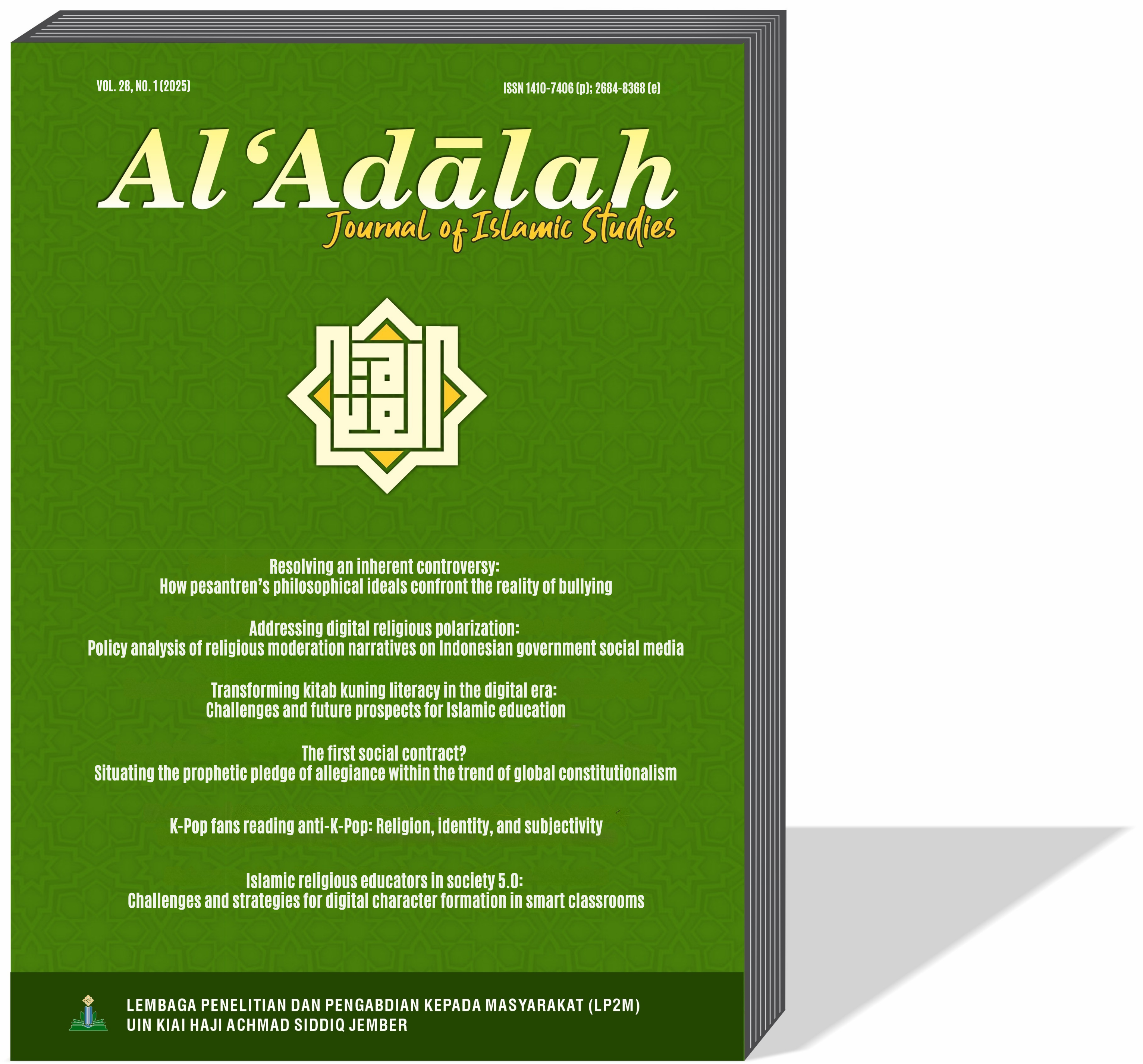
- Cover Image
-
- Downloads
- Published
- 2025-10-17
- Issue
- Vol. 28 No. 1 (2025)
- Section
- Articles
- License
-
Copyright (c) 2025 Okta Nurul Hidayati

This work is licensed under a Creative Commons Attribution-NonCommercial 4.0 International License.
Authors retain copyright in their published works and grant Al’Adalah: Journal of Islamic Studies the right of first publication.
Articles published under the journal's current licensing policy are distributed under the Creative Commons Attribution-NonCommercial 4.0 International License (CC BY-NC 4.0). This license permits readers to share and adapt the licensed material for noncommercial purposes, provided that appropriate credit is given, the original publication is acknowledged, a link to the license is provided, and any changes are indicated.
The license does not authorize commercial reuse without additional permission from the relevant rights holder, except where applicable copyright exceptions or limitations permit such use. Third-party materials may be subject to separate copyright restrictions.
Full license terms: https://creativecommons.org/licenses/by-nc/4.0/
Licensing arrangements for previously published articles remain subject to the terms applicable to those articles.
