MEMBANGUN MANAJEMEN EKONOMI BERPRINSIP SYARIAH
- Authors
-
-
Moh. Asra MaksumIAI Ibrahimy Sukorejo Situbondo
-
- Keywords
- Management of Economy, The principle of Sharia, Syariah Management
- Abstract
In islamic perspective everything must be done, in a tidy manner true, orderly, regular, directed clear and settled to an end. The process must always followed well. Nothing is certainly not be done in not planned because it is a principle that major in Islamic beliefs. Rasulullah said in a hadith being narrated thabrani, the priest, “surely god loved one who, if do any work done in itqan (timely directed clear and settled)”.The clear work the steady, and transparent manner gotcha charity work which is loved by God. Actually, management in meaning regulate everything to do well quick, and it is been Sharia in Islamic Beliefs. Syariah management is the behavior associated with the values of faith and ketauhidan, every behavior one who engages in an activity based on tauhid with the value of, and expected behavior will be restrained and not occurring KKN behavior (corruption, collusion, and nepotism) because realized the supervision of the most high, which is god to record every charitable deeds both good and bad.This is different with the behavior in the management of conventional not at all related even in spite of tauhid values. Those who apply the management of conventional not feel the supervision that is attached, except only the supervision of the leader or a superior. Any activity in the management of Sharia, attempts to pious charity by perennial worth.
- Author Biography
-
Moh. Asra Maksum, IAI Ibrahimy Sukorejo Situbondo
Dosen Tetap Fakultas Syari’ah IAI Ibrahimy Situbondo
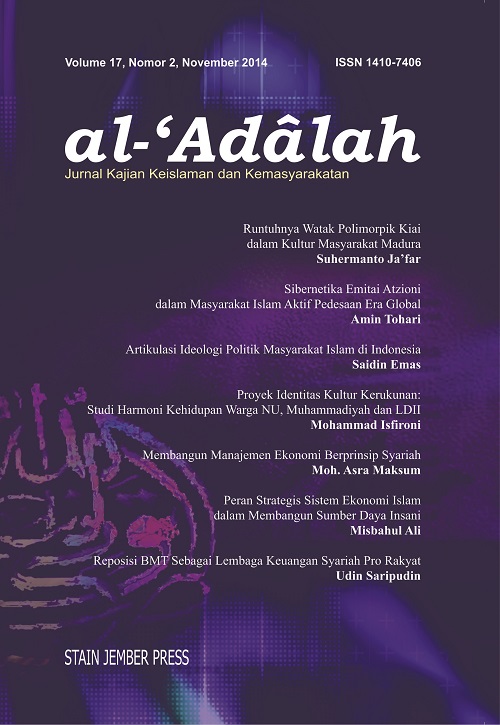
- Cover Image
-
- Published
- 2022-03-17
- Issue
- Vol. 17 No. 2 (2014)
- Section
- Articles
- License
-

This work is licensed under a Creative Commons Attribution-NonCommercial 4.0 International License.
Authors retain copyright in their published works and grant Al’Adalah: Journal of Islamic Studies the right of first publication.
Articles published under the journal's current licensing policy are distributed under the Creative Commons Attribution-NonCommercial 4.0 International License (CC BY-NC 4.0). This license permits readers to share and adapt the licensed material for noncommercial purposes, provided that appropriate credit is given, the original publication is acknowledged, a link to the license is provided, and any changes are indicated.
The license does not authorize commercial reuse without additional permission from the relevant rights holder, except where applicable copyright exceptions or limitations permit such use. Third-party materials may be subject to separate copyright restrictions.
Full license terms: https://creativecommons.org/licenses/by-nc/4.0/
Licensing arrangements for previously published articles remain subject to the terms applicable to those articles.
